Google Split the TPU into Two Chips: Pragmatism Over Versatility
Published on 4/28/2026
•
Engineering
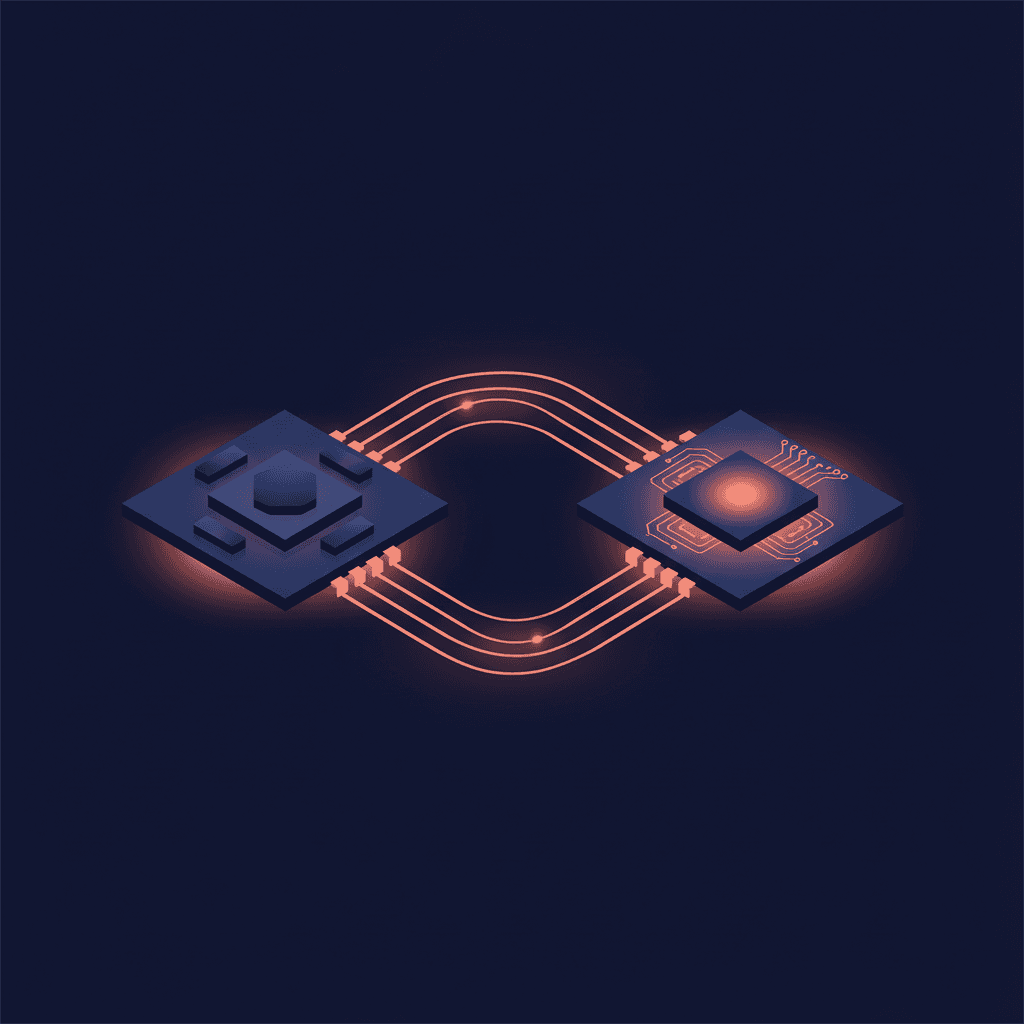
When an infrastructure giant decides not to make "one chip for everything" but releases two different chips for training and inference, it's a signal not so much about technology as about how the economics of AI workloads are changing. Google announced the eighth generation of TPUs with a split into training and inference variants — for the first time in the program's ten-year history.
Two Chips Instead of One: What's Behind the Decision
Previously, TPUs were universal: one chip for both training and inference. Now Google is releasing two different dies — one optimized for compute-heavy training, the other for lightweight, high-volume inference. At first glance, it complicates the lineup. But from a total cost of ownership perspective, it's pure pragmatism.
A training chip requires high memory bandwidth, large matrix multipliers, and dense interconnects. An inference chip needs to minimize latency and energy consumption per request, not per teraflop. When inference volume starts to dominate (and at Google, it already has), a universal chip pays for unnecessary complexity on every request. The split is a way to reduce TCO, not just "surprise the market."
Scale: A Cluster of Up to a Million TPUs
Separately, it's worth noting that Google claims the ability to connect up to 1 million TPUs into a single cluster — an order of magnitude larger than Nvidia with their NVLink domains. For those designing distributed training, this means the network topology becomes the main bottleneck, not the capacity of a single chip. In practice, this means Google can train models that Nvidia physically cannot fit into a single logical space.
But for the average customer, such scale is more of a marketing signal than a real opportunity. We wouldn't advise building an architecture around the hypothesis "what if we need a million chips" — even in Google's cloud, renting such a cluster would cost as much as a small country's GDP.
Pragmatism Over Hype
Splitting into two chips is also a sign of market maturity. When AI workloads were experimental, versatility made sense: one type of accelerator for all tasks simplified planning. But when inference becomes the main cost driver (as in search, YouTube, Gemini), optimizing for it yields real savings. In our experience, in projects with a high inference/training ratio (chatbots, recommendation systems, document processing), it's the cost of inference that determines ROI, not training speed.
For teams choosing infrastructure for an AI product, this news is not a reason to switch to TPUs, but a reminder: a universal solution is almost always more expensive than a specialized one at scale. If your project grows, you too will have to choose between "one chip for everything" and "two chips for different tasks." Google made this choice for itself. When you'll have to make it is a matter of time.
Related articles
Starship V3: space construction where blueprints are written mid-flight
SpaceX launched Starship V3 — successfully, but without reaching orbit. We break down why the "fail fast" approach works in space and IT, and when it's better to draw first and build later.
5/24/2026
When Memory Costs More Than GPU: What Nvidia Doesn't Say in Vera Rubin Presentations
Memory in Nvidia's new AI systems has jumped 485% in cost, now making up 25% of rack price. We break down why GPU isn't the main expense and how to calculate TCO for AI infrastructure.
5/22/2026
VS Code Extension as Entry Point: 3800 Repositories Compromised
Leak of 3800 GitHub repos via malicious VS Code extension: why IDEs are a security weak spot and how to reduce risk without banning plugins.
5/21/2026